
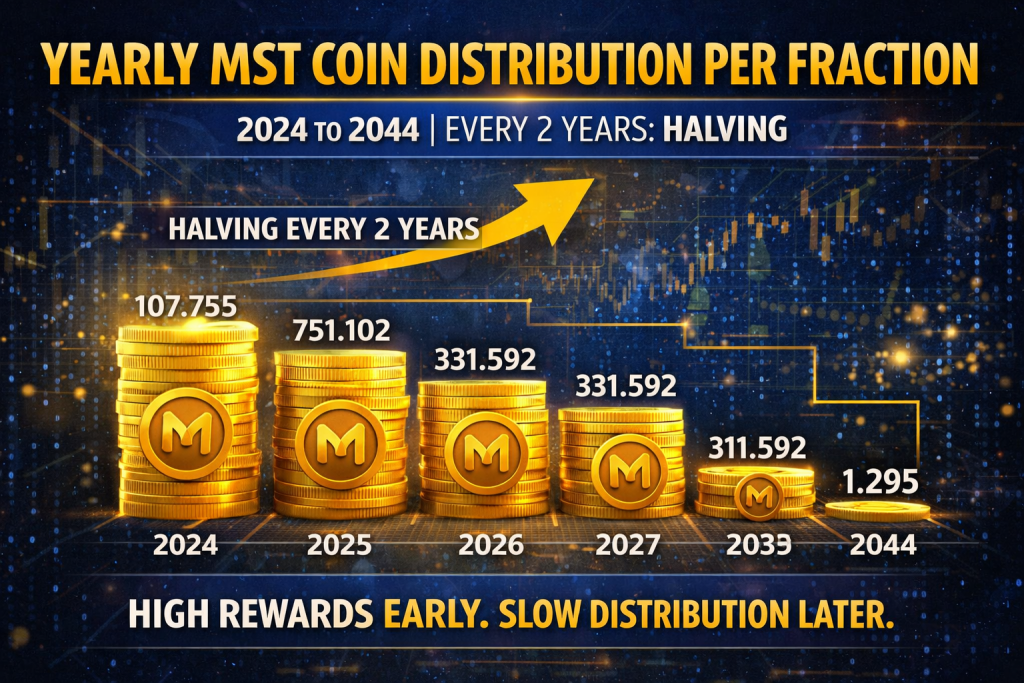
Understanding how rewards are distributed over time is essential in any blockchain ecosystem. The MST coin distribution model follows a structured long-term plan, where rewards are allocated across 29.4 lakh fractions and gradually reduced through a halving mechanism.
This blog breaks down the year-by-year coin distribution per fraction and explains what it means for participants.
How MST Coin Distribution Works
The distribution begins on 7 November 2024 and continues until 2044. Coins are distributed equally across all fractions, ensuring a fair and transparent allocation system.
A key feature of this model is halving, which occurs every 2 years. With each halving:
- The number of coins distributed is reduced by 50%
- The supply becomes more controlled
- Scarcity gradually increases
Year-by-Year Rewards Per Fraction
Below is the approximate number of coins received per fraction each year:
- 2024 (Nov–Dec) → ~107.755 coins
- 2025 → ~751.102 coins
- 2026 → ~648.447 coins
- 2027 → ~357.551 coins
- 2028 → ~331.592 coins
- 2029 → ~178.716 coins
- 2030 → ~165.306 coins
- 2031 → ~89.388 coins
- 2032 → ~83.808 coins
- 2033 → ~44.694 coins
- 2034 → ~41.327 coins
- 2035 → ~21.347 coins
- 2036 → ~20.774 coins
- 2037 → ~11.173 coins
- 2038 → ~10.332 coins
- 2039 → ~5.587 coins
- 2040 → ~5.181 coins
- 2041 → ~2.793 coins
- 2042 → ~2.589 coins
- 2043 → ~1.397 coins
- 2044 → ~1.295 coins
Understanding the Halving Effect
Every 2 years, the reward distribution is reduced by half. This means:
- Early years provide higher rewards
- Later years provide lower but controlled distribution
- Total supply is released gradually over time
This model ensures long-term sustainability and avoids sudden inflation in the system.
Total Distribution Overview
- Total supply distributed: ~8.48 billion coins
- Total coins per fraction (2024–2044): ~2883.564 coins
This shows that a significant portion of rewards is distributed in the early years, while the remaining supply is released slowly over nearly two decades.
Why This Model Matters
This structured distribution system offers several advantages:
1. Fair Allocation
All fractions receive equal distribution over time.
2. Supply Control
Halving ensures that coin supply does not increase too rapidly.
3. Early Participation Advantage
Higher rewards in initial years encourage early engagement.
4. Long-Term Stability
Gradual distribution supports a balanced ecosystem.
Key Takeaway
The MST coin distribution model is designed with a 20-year vision, combining fairness, scarcity, and sustainability. As rewards decrease over time due to halving, understanding this structure helps participants align their expectations with the long-term roadmap.
Conclusion
From 2024 to 2044, MST coin distribution follows a predictable and transparent path. Early years offer higher rewards, while later years focus on controlled supply and ecosystem stability.
For anyone exploring this ecosystem, understanding the yearly reward structure and halving cycle is crucial for making informed decisions and planning long-term participation.