Blockchain technology has evolved far beyond cryptocurrencies and is now transforming multiple industries. Its core features—decentralization, transparency, security, and immutability—make it a powerful solution for real-world problems.
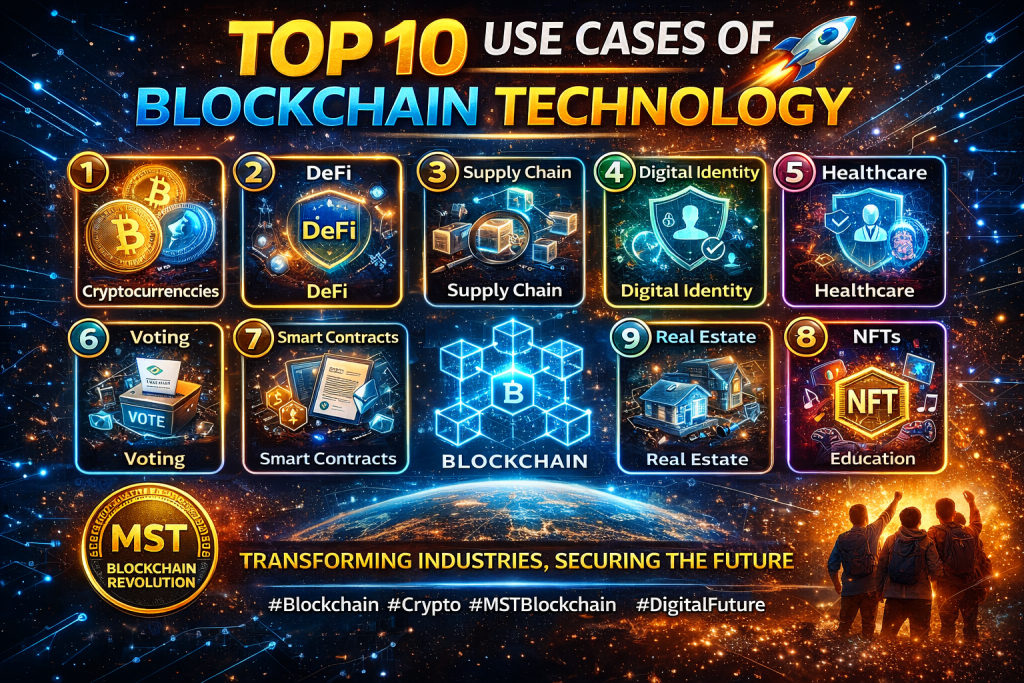
In this blog, we explore the top 10 use cases of blockchain technology that are shaping the future of digital systems.
1. Cryptocurrencies & Digital Payments
The most well-known use of blockchain is in cryptocurrencies like Bitcoin and Ethereum. Blockchain enables:
- Secure peer-to-peer transactions
- Faster cross-border payments
- Reduced transaction costs
It eliminates the need for intermediaries like banks, making payments more efficient.
2. Decentralized Finance (DeFi)
DeFi is revolutionizing traditional financial systems by offering services such as:
- Lending and borrowing
- Trading without intermediaries
- Yield farming and staking
All these operate on smart contracts, ensuring transparency and automation.
3. Supply Chain Management
Blockchain provides complete visibility across supply chains. It helps in:
- Tracking products from origin to delivery
- Preventing fraud and counterfeit goods
- Improving efficiency and trust
Industries like food, agriculture, and pharmaceuticals are already benefiting from this.
4. Digital Identity Verification
Blockchain can securely store and manage digital identities, allowing users to control their personal data.
Benefits include:
- Reduced identity theft
- Faster verification processes
- Improved privacy
Governments and organizations are exploring this use case extensively.
5. Healthcare Data Management
Blockchain ensures secure storage and sharing of medical records.
It allows:
- Safe patient data storage
- Easy transfer between hospitals
- Improved accuracy and privacy
This can significantly enhance healthcare systems globally.
6. Voting Systems
Blockchain can make voting systems more transparent and secure by:
- Preventing tampering
- Ensuring voter anonymity
- Providing verifiable results
It has the potential to improve trust in democratic processes.
7. Smart Contracts
Smart contracts are self-executing agreements written on blockchain.
They:
- Automate processes
- Reduce the need for intermediaries
- Ensure accuracy and efficiency
Widely used in finance, real estate, and legal systems.
8. Real Estate & Property Records
Blockchain can simplify property transactions by:
- Digitizing land records
- Reducing fraud
- Speeding up ownership transfers
It enhances transparency and reduces paperwork.
9. Education & Certification
Blockchain can store academic records and certificates securely.
Benefits:
- Prevent fake degrees
- Easy verification of credentials
- Lifetime accessibility
This is especially useful for global education systems.
10. NFTs & Digital Ownership
Non-Fungible Tokens (NFTs) enable ownership of digital assets such as:
- Art
- Music
- Gaming assets
Blockchain ensures authenticity and ownership rights in the digital world.
Conclusion
Blockchain technology is no longer limited to finance—it is transforming industries across the board. From healthcare and education to governance and supply chains, its applications are vast and continuously expanding.
As adoption grows, blockchain will play a crucial role in building a secure, transparent, and decentralized digital future.